PDV is an architectural paradigm, not a particular vehicle shape.
Framework · Introduced 2026
Passenger-Defined
Vehicle (PDV)
A vehicle-architecture framework for the post-driver era.
A Passenger-Defined Vehicle is one in which passenger needs become primary upstream inputs to the physical architecture, digital systems, and mobility experience — enabled by the reduction or removal of traditional driver-centric constraints.
01 Definition
The formal definition
A Passenger-Defined Vehicle (PDV) is a vehicle in which passenger needs become primary upstream inputs to the physical architecture, digital systems, and mobility experience, enabled by the reduction or removal of traditional driver-centric constraints.
Source Anto, S. J. · Passenger-Defined Vehicles (PDVs): The Architectural Paradigm of the Post-Driver Era · Version 1.0 · August 2026 · DOI 10.5281/zenodo.21868937
02 The architectural shift
When the driver is no longer the organizing constraint
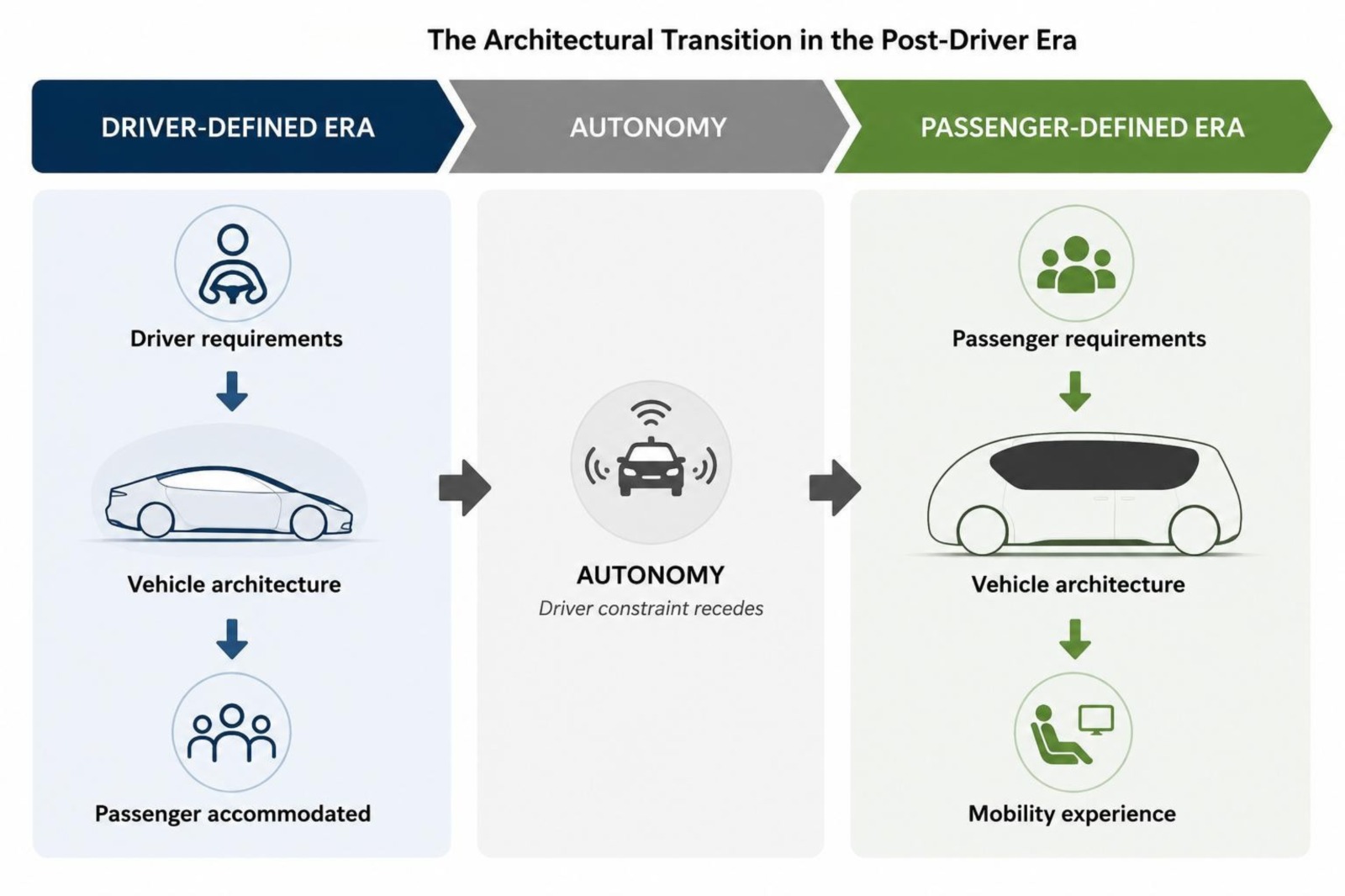
For more than a century, vehicle architecture has been organized around the requirement that a human must drive. That requirement shaped controls, visibility, seating, cabin orientation, packaging, human-machine interfaces, and interior space.
High driving automation creates a further architectural inflection point: when the human driver is no longer a necessary organizing constraint, passenger requirements can become the primary reference for vehicle architecture.
03 The framework
A spectrum, not a body style
PDV is intentionally not restricted to a particular body style, seating count, compartment configuration, ownership model, or mobility service. Passenger-definedness is a spectrum rather than a binary label. Existing purpose-built autonomous vehicles may already exhibit passenger-defined characteristics, while future architectures may carry the principle further.
Driver-centric architecture
Increasingly passenger-defined
It is not defined by a specific body style, seating capacity, compartment configuration, ownership model, or mobility service.
Passenger-definedness should be understood as a spectrum. Existing purpose-built autonomous vehicles may already exhibit passenger-defined characteristics.
04 Where PDV sits
PDV in relation to EV, SDV and AV
EV
Electric Vehicle
Changes how the vehicle is propelled.
SDV
Software-Defined Vehicle
Changes how vehicle functions are created, managed and evolved.
AV
Autonomous Vehicle
Changes who or what performs the driving task.
PDV
Passenger-Defined Vehicle
Changes the primary architectural reference around which the vehicle is designed.
PDV is therefore not a replacement for EV, SDV or AV. It describes a different architectural dimension.
05 Foundational publication

Passenger-Defined Vehicles (PDVs): The Architectural Paradigm of the Post-Driver Era
06 About the originator

Shalin James Anto
Founder & CEO, PLIYT, Inc.
Shalin James Anto is the Founder & CEO of PLIYT, Inc. and the originator of the Passenger-Defined Vehicle (PDV) framework. Drawing on more than fifteen years of automotive R&D experience across vehicle systems, autonomy, and advanced research, he introduced and formalized PDV as a vehicle-architecture and design framework for the post-driver era.
07 Frequently asked questions
Common questions about PDV
What is a Passenger-Defined Vehicle (PDV)?
A Passenger-Defined Vehicle (PDV) is a vehicle in which passenger needs become primary upstream inputs to the physical architecture, digital systems, and mobility experience, enabled by the reduction or removal of traditional driver-centric constraints.
What does PDV stand for?
PDV stands for Passenger-Defined Vehicle. In the plural, Passenger-Defined Vehicles (PDVs), the term describes the category of vehicles built around this architectural paradigm — introduced and formalized by Shalin James Anto in 2026.
How is a PDV different from an autonomous vehicle (AV)?
An autonomous vehicle changes who or what performs the driving task. A Passenger-Defined Vehicle changes the primary architectural reference around which the vehicle is designed. High driving automation is often what removes the driver-centric constraint, but automation and passenger-definedness are separate dimensions — PDV describes what happens to the architecture once that constraint recedes.
Is a PDV the same as a software-defined vehicle (SDV)?
No. A software-defined vehicle changes how vehicle functions are created, managed and evolved. PDV describes a different architectural dimension: what the vehicle's design is organized around. The two are not mutually exclusive — a vehicle can be software-defined and passenger-defined at the same time.
What is the “post-driver era”?
The post-driver era refers to the point at which high driving automation removes the requirement that a human must drive, so the human driver is no longer a necessary organizing constraint on vehicle architecture. That inflection point is what allows passenger requirements to become the primary reference for architecture instead.
Is every autonomous vehicle a PDV?
Not automatically. Passenger-definedness is a spectrum, not a binary label — PDV is not restricted to a particular body style, seating count, compartment configuration, ownership model, or mobility service. Some existing purpose-built autonomous vehicles may already exhibit passenger-defined characteristics, but automation alone does not make a vehicle passenger-defined.